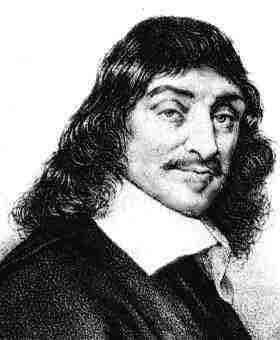
 "I think, therefore I am." Almost everyone has heard of this saying, but what does it mean?
It was coined by René Descartes, a famous mathematician, philosopher and scientist who lived in the 17th century. The phrase sums up one of the arguments he gave in his Meditations. If one truly opens one's mind to the possibility of what this argument is saying, it can lead to quite an altered state of mind, and a complete revision of this experience called 'reality'. It is not unlike that feeling one has at the end of some movies where a piece of information is given which forces you to reevaluate every scene which came before.
Descartes is sitting comfortably by the fire. He decides to take on the challenge of discovering if there is anything that we humans can be absolutely certain of knowing. Can he be sure, for instance, that he is in fact sitting comfortable by the fire? He thinks that he could be having a dream. So what can he be sure of?
Descartes begins his search by pretending that there is a demon who is continually inserting false beliefs into his head. So now, when he sees and feels the warmth of the fire, he can't be sure that the fire is there, as these sensations could have been thrown into his head by the demon. Descartes leaves his writing for a little in this skeptical frame of mind, being cautious not to be deceived by the demon. Everything that he sees, hears, touches, smells and tastes is no longer an indication of what is.
So when he returns to his writings, what does he find? He realises that the whole world might be an illusion created by the demon. Nothing around him, not even his own body, necessarily exists. But there is one thing that he can be sure of, and this is that he has thoughts. Therefore, his mind must exist! Otherwise, if the demon wanted to make him believe that he had no mind, he would have to insert that belief into his head, and he couldn't do this unless Descartes had one! Therefore, by logical necessity, if there is anything that he could be sure of, it is that if he thinks, he must exist. Hence the phrase: "I think, therefore I am."
However, this does not mean that we can be sure that other people exist - all we know is that "I", the thinker, exist. It is very possible that every single other person which you perceive on a day-to-day basis does not, in fact, think, but only has the appearance of doing so. What a frightening idea. You might like to try being suspicious of everything you see, hear or smell for the next few days, it really is a bizarre exercise. Of course, you don't have to believe in the demon, only the possibility that what you believe about this world may be a figment of your mind.
Further Reading:
- Descartes, R., Meditations on First Philosophy
- Bouwsma, O. K., 1949, "Descartes' Evil Genius", Philosophical Review 58, pp. 141 - 151


3 comments:
air max, sac longchamp, ray ban sunglasses, longchamp pas cher, ugg boots, ray ban sunglasses, nike free, oakley sunglasses, nike free, chanel handbags, cheap oakley sunglasses, nike outlet, louboutin, longchamp, nike roshe run, air jordan pas cher, tiffany jewelry, longchamp outlet, longchamp outlet, michael kors, prada outlet, louis vuitton outlet, louboutin outlet, louis vuitton, uggs on sale, ugg boots, louis vuitton, polo ralph lauren outlet, oakley sunglasses, louis vuitton, kate spade outlet, louboutin pas cher, polo ralph lauren outlet, tory burch outlet, tiffany and co, oakley sunglasses, ray ban sunglasses, ralph lauren pas cher, christian louboutin outlet, nike air max, nike air max, louboutin shoes, replica watches, jordan shoes, oakley sunglasses, gucci outlet, prada handbags, burberry, replica watches, louis vuitton outlet
wedding dresses, giuseppe zanotti, instyler, mont blanc, converse outlet, longchamp, babyliss, north face outlet, north face outlet, insanity workout, gucci, vans, hollister, asics running shoes, chi flat iron, ralph lauren, baseball bats, bottega veneta, timberland boots, mac cosmetics, valentino shoes, abercrombie and fitch, mcm handbags, hollister, lululemon, nike air max, hollister, celine handbags, herve leger, ghd, louboutin, soccer jerseys, p90x workout, beats by dre, vans shoes, ray ban, nike air max, nike trainers, new balance, ferragamo shoes, nike huarache, reebok shoes, lancel, nfl jerseys, nike roshe, oakley, iphone cases, jimmy choo shoes, birkin bag, soccer shoes
bottes ugg, ugg pas cher, louis vuitton, pandora jewelry, moncler, moncler, doudoune canada goose, replica watches, louis vuitton, moncler, juicy couture outlet, moncler, juicy couture outlet, ugg,uggs,uggs canada, canada goose, ugg,ugg australia,ugg italia, pandora charms, canada goose, links of london, canada goose outlet, pandora charms, canada goose uk, canada goose, marc jacobs, moncler, wedding dresses, louis vuitton, canada goose outlet, karen millen, louis vuitton, moncler outlet, sac louis vuitton pas cher, coach outlet, moncler, swarovski, ugg boots uk, toms shoes, moncler, pandora jewelry, canada goose, montre pas cher, thomas sabo, supra shoes, hollister, swarovski crystal
Post a Comment